Sunday, 28 July 2013

How to milk an auroch -- part one

Bos Longifrons on  a British
Celtic bucket mount. Image
Cow's head bucket mounts are a very familiar object in British early Celtic art. The mount connects the handle to the top edge of a milking bucket. In all but one example, the species of cow depicted is Bos Longifrons – often still called the “Celtic shorthorn”. In all examples, the cow's face looks out from the side of the bucket, and is best seen from that viewpoint. Most of these seem to date to the early first century AD.

British Celtic bucket mount which apparently depicts
the auroch. Circa 200 BC. In curent coll.
The single exception to the above is this example which differs in all points. First, the species appears to be Bos Primigenius, better known as the auroch. Aurochs are depicted in early cave paintings and are thought to have gone extinct in Britain during the Bronze Age, although they lasted on the continent until the seventeenth century. Caesar talks of them in his commentaries (VI, 28):

“... an animal somewhat smaller than the elephant, with the appearance, colour and shape of a bull. They are very strong and agile, and attack every man and beast they catch sight of. The natives [Germans]take great pains to trap them in pits, and then kill them. This arduous sport toughens the young men and keeps them and keeps them in training; and those who kill the largest number exhibit the horns in public to show what they have done, and earn high praise. It is impossible to domesticate or tame the aurochs, even if it is caught young. The horns are much larger than those of our oxen, and of quite different shape and appearance. The Germans prize them greatly: they mount the rims with silver and use them as drinking-cups at their grandest banquets.”

Much earlier, Herodotus (4, 183) is thought to have been referring to the auroch when he wrote “... the cows walk backwards as they graze; the reason for this habit is that their horns curve forwards – so much so that if they walk forwards as they graze, the horns stick into the ground in front of them, and so they move backwards.”

The second difference between this mount and the common sort is the way it is attached to the bucket: instead of being an appliqué facing outwards on the side of the bucket, the mount is attached so that the cow's head faces upwards where it would face the person using the milking bucket. This is an uncommon feature in early Celtic art: in a few examples, objects were decorated to be seen best by the person using the object, and not by another observer. This fact was first discussed by Sir Cyril Fox in Pattern and Purpose: A Survey of Early Celtic Art in Britain, National Museum of Wales, 1958, p. 23.

The mount is of bronze, 40 mm wide, 25 mm deep, and 20 mm high and with a smooth, black patina. It was found in the mid-eighties near St. Albans in Hertfordshire (the ancient Verolamium) in the territory of the Catuvellauni.


So did the Celts actually manage to tame the auroch at some point? Does this mount depict a real descendant of the wild auroch, or another species with some primitive features? In future episodes, we will look at these questions as well as modern attempts to bring back the wild auroch from its extinction.  

Tuesday, 16 July 2013

The seal of Alexander the Great -- part two

Click to enlarge

Catalogue worksheet

Ancient Greece

Alexander III (The Great) 336-323 BC

Pb uniface seal, 18 mm, 10.1 g. circa 331- 305 BC

ALEXAN/DROU Lion advancing right on ground line.

Die engraver: Pyrgoteles

No find spot was recorded.


All of the evidence for this attribution will be covered in subsequent posts. This will include the epigraphy, iconography, style, history and legends. The dating of the seal given here starts with Alexander's arrival at Babylon, and ends with Kassander assuming the title of King in Macedonia. Prior to 305 BC, the coins are all in the name of Alexander, and it is safe to assume that this would also be true for official seals. Seals such as this were used for international correspondence by officials in the Alexandrine Empire

Monday, 15 July 2013

After the flood

John Lennon said that life is what happens to you while you're busy making other plans. Yes, life does that. The series of events that has delayed my blog entries started with a new computer and new operating system. Like many people, I discovered that going from Windows XP home edition and 32 bits to Windows 7 Professional and 64 bits was not without its problems. Many applications and even documents just could not make the transition. Retrospectively, this was just a trifle. I got new software, learned how to use it and came up with some work-a rounds.

Then the flood hit. It was the most devastating flood in Alberta's history. We had a lot of rain in the Calgary area and the ground was sodden. At first, this seemed fortunate for all of the gardeners – this was the time of year when the last frosts had passed and everything was planted. Usually, there is little rain at that time and the seed beds have to be watered frequently. So rain is good. I even regretted not gardening any more – the conditions seemed perfect.

Artist friend Monte Christoffersen showing six
feet of river silt on the trees near the Elbow River
in Calgary
The problem was a weather system sitting in the mountains, moist air from the coast hit the Rockies and condensed causing heavy rain that just did not let up. The rivers swelled, the dam lakes filled and there was nowhere for the water to go in the Bow Valley but downstream to Calgary. Nothing could have prevented that. To the south of Calgary, the town of High River was devastated from the flood of its own river. 5,200 homes and businesses were damaged by the flood – many of them beyond repair. The town was uninhabitable and four of the five flood fatalities were due to that particular flood. The fifth victim was an elderly woman in Calgary who refused to be evacuated. She drowned in her own apartment. Although many parts of Calgary were also devastated, we have lots of high ground. I live 200 feet above the high water level, and walking around my neighborhood, there was no sign of anything wrong at all.

Downtown Calgary was without power and virtually a ghost town. Many houses and businesses in the flood plain of the Bow and Elbow rivers had flood levels of about six feet. The loss of property was almost unimaginable. Through it all, Naheed Nenshi, the Mayor of Calgary, soon became a folk hero by taking control of everything and helping to keep the morale high. The only complaints he received were from people telling him that he needed to sleep once in awhile!

Calgary has long been known as “the volunteer capital of Canada”, and in the face of such adversity, the volunteer numbers swelled. At first, travel was restricted. Various roads and bridges were closed and everyone was told to stay at home as much as possible for four days. The danger to life was extreme near the rivers. There was virtually no looting and Calgarians really came together even more than usual. Many other Canadians also came to help – even Prime Minister Stephen Harper and Liberal Party Leader, Justin Trudeau went to High River, literally “mucking in” with the other volunteers there.

Winston, 1999-2013
Although above the water, I was enmeshed in my own personal tragedy. Winston, my 14 year old Border Collie/ Black lab Cross had a series of fatal seizures and I could not get him to a vet. For those four days, I kept him as comfortable as possible. He could not stand or even sit up. He had no bladder or bowel control and was refusing food and water. After two days, I managed to get him to drink again. I put in 20 hour days just keeping him as clean and comfortable as possible. He responded well to this attention and was not in any pain. In that time he only whined a couple of times, stopping as soon as I stroked his back. On the fifth day, travel was again possible for me, and with my daughter and her husband, we took Winston for his last visit to the vet. He was the best dog I ever owned and was very popular with my friends and neighbours, many of them were amazed at his intelligence and abilities. He had been part of my family for 14 years and I miss him terribly.

After the flood and Winston's death, I was able to help out a friend a little with his flood damaged shop – fortunately, he only had a couple of inches of water and little stock was lost. He had also been temporarily displaced from his apartment but is back there now – even though the elevators won't be working for a few weeks and he lives on the sixth floor.


The flood could have been much worse. I knew this because in 1998/9 I drew the emergency “worst case scenario” flood maps for the Bow river. The biggest danger of all would have been a dam breach at Lake Minnewanka in the mountains. That lake is seventeen miles long and 466 feet deep. It has an earth dam. Usually, this is the strongest of all dam types, but if the water overspills the dam, then it will erode and the dam will fail. This fact was not released to the public, but the dam workers were able to release water from a spillway which caused far less damage. Had Minnewanka dam failed, there would have been two stories of water downtown and Calgary would have been uninhabitable for a long time.

Tuesday, 11 June 2013

Now in 3D!

British boss fragment in repoussé bronze. Early 2nd century B.C. In current coll.
This fragment is only 3.1 cm wide and is paper-thin. That it survived in the earth for over two thousand years even in this fragmentary state is quite remarkable. A two dimensional photograph does little justice to the skill of the smith who made this piece.

To see the image in 3D, look at the picture and the go slightly cross-eyed until you see two pictures. Next, adjust your sight so that the double images start to move toward each other. You need to align the right side of the left image with the left side of the right image to produce a 3d view in the centre. You might need to change the angle of your head to align them properly. It is easiest to align a small detail. Once you have the 3D image, you can inspect any part of it and your eyes will adjust automatically as if it is a real image you are looking at. Click on the picture for an enlarged version.

Thursday, 23 May 2013

The seal of Alexander the Great -- part one


One of the greatest joys in being a collector is finding a great bargain. More often than not, it will be something that lacks proper identification. After all, people usually do not give things away.  Of course, ethics comes into the picture, so if I am offered something for sale by a member of the public and I see that it might be very valuable, I will identify it for the seller and offer them advice on what to do with it. Sometimes, the seller might ask me to handle the sale and I will usually ask for a small brokerage fee to do this.

All of my best bargains have come from auctions, and quite often I am the only person bidding who thinks the object might well be something very special. Every week I get many email auction notifications and if a sale seems interesting enough, then I will study the catalogue. I almost always bid only on on-line auctions where I can see the latest bids. Most of my buys of this nature are based on nothing more than a suspicion, and I am not always right. Sometimes, though, I am fairly sure of my identification.

A few years ago, I came across one of the greatest bargains of all and I was fairly confident in what I was looking at – a lead seal impression of Alexander the Great. The auction house did not specialize in this sort of material. Now, no one knows what Alexander’s seal looked like, even though we know that the man who
Posthumous portrait of Alexander the Great
Image courtesy of  Classical Numismatic Group, Inc

made all of Alexander’s seals was named Pyrogoteles. These seals would have been issued to certain people in the Alexandrine Empire for use on official documents, so there were probably quite a number of them made. The seal impression bore the name of Alexander (Alexandrou) and I was not the only bidder who had a tentative attribution because the price soon greatly exceeded what would usually be paid for an ancient Greek lead seal impression. I decided that my only hope of obtaining it was to snipe the auction in the last few seconds and to bid all that I could afford. To say that this made me rather nervous would be an understatement! Apparently, either my confidence or my budget was higher than at least one other bidder because I won the seal. Being confident about the attribution is one thing, but to supply good evidence for such an attribution is another matter and my research continued for another seven years!

Before I present all of the evidence, let us “fast-forward” to late last year: I often show objects from my collection to people whom I think might be interested.  These are often people that I might see frequently at various companies that I visit – I once even gave a presentation to a class at my daughter’s school. Usually the reaction is something like “Cool!” or “Wow! I've never held anything that old!”

Karmen holds the seal of  Alexander the Great
Karmen’s reaction was unlike any other. I placed the seal impression in her hand and told her what it was. She said nothing at all and just stared at it. It was her expression that surprised me the most. I would liken it to the expression you see in Raphael’s paintings where Mary is looking down at the infant Jesus in her arms. This was so unusual that I asked her about it. She replied that her mother was born in Skopje, the capital of the Republic of Macedonia.

Alexander the Great was born in Pella, the capital of ancient Macedonia – now in modern Greece. Political boundaries change over the centuries, but a sense of cultural belonging does not change with the boundaries – that attitude is mere nationalism. In fact, although Karmen’s mother came from Skopje, Karmen, herself, is Canadian – from British Columbia. This fact made no difference at all to the cultural connection she made with the object in her hand. Nor should it: cultural identity is a personal thing – it did not need the fact of Canada’s official multicultural policies, or a certain country’s name on a birth certificate, to exist.

Monday, 6 May 2013

Collecting early Celtic art -- part three


Shield handle mount, one of
three known, the other two
being on the Chertsey Shield
in the BritishMuseum.
4th to 3rd cent BC
Not currently in coll. 
In searching for predecessors of the Celts, scholars of various disciplines are attracted to the Urnfield culture of central Europe which flourished between the twelfth and the eighth centuries B.C. This appears to be the time when the proto-Celtic language was forming and a number of artistic or iconographic motifs that appear during the Celtic La Tène, such as the water-bird motif (which we saw on the French brooch in part one) have their genesis during this earlier period.

In northern Italy, the Urnfield culture of central Europe develops into the Golasecca Culture and the first Celtic movements into northern Italy influences the Golasecca culture as do the Situla culture and the Etruscan culture . This becomes especially confusing to those who like their history compartmentalized as we see, in northern Italy, a surprisingly early cosmopolitan society and this characteristic lasts for many centuries passing its influences on to Rome. The situation is made even more complicated by a general lack of clear archaeological evidence. It seems that the development of the Roman empire, much later helped to eradicate much of the evidence of earlier cultures. However, we do see examples where the cosmopolitan flavor is well-attested: Celtic cemeteries in northern Italy which contain Etruscan inscriptions and jewelry  Celtic Hallstatt period brooches and even Greek strigils. There was nothing strange about intermarriage between any of the cultures and one might be hard-pressed to define the ethnicity of any given household as there was so much borrowing between the cultures.

It is hardly surprising that such a region would attract people from far and wide with its pleasant weather, ample produce and other resources. As more people arrived they brought with them their own skills which further expanded the product supply of the region and thus attracted even more arrivals. The Celts were represented very early by the Cisalpine Insubres who settled in the area of Milan and perhaps founded that city (Mediolanum). The Cenomani, who gave their name to Le Mans in France, crossed into Italy and ousted the Etruscans to the east of the territory of Insubres, The Boii were widespread -- lending their name to Bohemia (now in the Czech Republic). In Italy they captured the Etruscan town of Felsina which is now known as Bologna. According to Cato (quoted by Pliny ) the Boii consisted of 112 tribes (but what was probably meant was 112 clans). To the east of them, around the mouth of the Po, lived a branch of the Lingones who had moved there from the French department of Haute-Marne. Further south, the Senones, whose homeland includes the modern French departments of  Seine-et-Marne, Loiret and Yonne, occupied the Umbrian lands between Ariminum and Ancona on the east coast.


Coin of Ariminum in Umbria showing Celtic
warrior with shield and spear. 
Image courtesy of  Classical Numismatic Group, Inc
  A coin of Ariminum , minted after 268 B.C.   depicts a Celtic warrior, no doubt a member of   the Senones, armed with an oval shield and a   spear. Most puzzling are the Veneti (Venice).   Much about their culture appears to have been   Celtic but their language was, at the very least, a   different dialect native to northern Italy. It thus   seems unlikely that they were the same Veneti   who occupied southern Brittany, but it is   possible that some sort of partial migration took   place in one direction or the other.

The Celts in northern Italy were much more than mere settlers. Their society was warrior based and it would be no exaggeration to say that they were in the business of war. From the ancient Greek writers onward, we are told that the Celts hired themselves out as mercenaries but this term gives an impression of a single soldier of fortune who joins a foreign army, perhaps along with a number of others like himself and together, they fight under their foreign commander using the strategies and tactics of the army they have joined. This was most likely the impression that was sought by the Greeks who would have rather liked to have saved most of the glory for themselves. In actual fact, the Celtic warriors were often more like auxiliary regiments who brought with them certain specialties. Polybius says: “The two largest tribes, therefore, the Insubres and Boii, made a league and sent messengers to the Gauls dwelling among the Alps and near the Rhone, who are called Gaesatae because they serve for hire, this being the proper meaning of the word." In actual fact, the term comes from the Celtic *gaison, meaning spear, and it should thus be understood that these mercenaries were really an auxiliary force of spearmen. The principle Celtic weaponry of shield and spear came to an end sometime around 200 BC.

This is an ongoing series, so do come back for more. Remember, all of my own images are free to use for any purpose -- no credits required.

Monday, 29 April 2013

A sweetgrass offering to the dinosaurs

A panorama of the view from where the sweetgrass braid was spotted. The image was mosaiced together from many shots with the distortions corrected, a technique commonly applied to aerial photographs in cartography


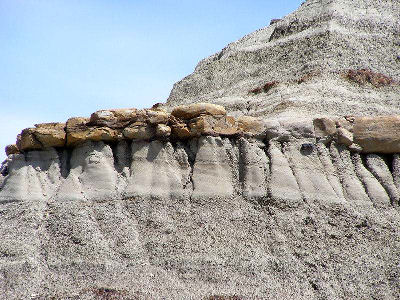
A typical formation at Dinosaur Provincial Park
Just 48 km northeast of Brooks, Alberta lies the world's richest deposits of dinosaur bones at Dinosaur Provincial Park. There, one can find more than 80 square km of strange-looking geological formations, wildlife,  and plants that most foreign visitors would not usually associate with Canada -- like the prickly pear cactus, for example. In some instances, the smell of sagebrush fills the air. Fossils are everywhere to be seen: in the rocks, in special displays, as the remains of ancient trees on the canyon floors -- even what might seem at first glance as just gravel and small stones can contain tiny pieces of fossilized dinosaur tendons, claws and teeth. The park occupies just one part of the vast Badlands of the Alberta prairies. Of course, you are not allowed to gather these fossil remains and take them home with you, and important fossil discoveries should be reported to the staff at the park. The landscape changes and new deposits are often revealed.


A cactus in flower near the sweetgrass braid
The main road into the park has various places where you park your car and take photographs of badlands that seem to stretch to the horizon -an alien landscape carved out of the flat prairies by millions of years of erosion. In one of these rest spots is the evidence of much later visitors to the area. Surrounded by a steel pipe fence just high enough to prevent car wheels from disturbing it is a tipi ring -- worn stones left by the retreating glaciers of the last Ice Age that the First Nations people gathered and used to weight down the sides of their tipis. By the geological standards of the area, these are modern. Yet these stones are partially buried in the ground at a depth that suggested to me that the tipi was here long before the white man first arrived in the area.

The sweetgrass braid in the centre of a tipi ring
In the middle of the tipi ring, I spotted something even more recent -- it was a massive braid of sweetgrass, a sacred plant to the Plains Indians, it was used in ceremonies and rites, in healings and to respect the land and all that it contained. "New Ager's" use it as well, and I often burn it at home too -- just for its pleasant aroma. You can buy small braids in shops here, for about $7.50. What I saw in plain view in that tipi ring was not a commercial braid, though. It was far too large. Such a braid would cost more than $50 in a shop, but such braids are not sold. I cannot say for sure that it had been placed there by a member of the First Nations, but it seems very likely. From its condition, it could not have been placed in that spot more than just a few months earlier. It had obviously never experienced a Canadian winter!

Even such a common plant as the thistle can
take on an alien look in such an environment
The tipi ring, itself, was in an odd location. On its own, it was positioned just a few metres from the edge of a cliff. It was certainly not part of a camp -- any sleepwalker might have come to a dramatic end within seconds of leaving that tipi! It might have been a lookout point, or perhaps it had a sacred function in the past. It certainly had one in the present as the sweetgrass braid attested.

One of the long-term
residents of the park
The fact that many visitors to that parking area must have seen it and yet no one took it, says something about our encounters with the sacred as expressions of other cultures. Canada, of course, is multicultural. We are famous for the respect we give to other cultures and people who arrive here from less tolerant places are always amazed at the friendliness of their new neighbours toward them. Of course, there can always be a few exceptions, but the overall response is overwhelmingly friendly. As a nation, we do not admire racist feelings in any form, and NATO has long used Canadian troops as peacekeepers. Canadians are known to be friendly and polite. I once heard a story about a very perceptive police detective in Los Angeles. A woman was found wandering around suffering from total amnesia. After checking missing person reports, the police were no closer to discovering her identity, when this detective noticed that she was exceptionally polite. He reasoned from this that she had to be Canadian! Shortly after contacting the RCMP in Canada she was on her way back home to her friends and relatives. I don't know if the story is true or if it is an urban myth.
An ancient cottonwood in the park


It was strange that the tipi ring was in that spot. It was also strange that there was a modern sweetgrass braid in the centre of the ring. What was not strange, however, was that no one had taken it away.

Collecting early Celtic art -- part two


There are a few field archaeologists who think that they understand context, but who really do not, and who look down their noses at people who study objects instead of archaeological sites. An object is simply something that is designated to be so. Ironically, such designations are not objective -- they are subjective. The subject is the observer. To find a pure object, you would have to go way down to the sub-atomic level -- and even then, a physicist in the future might break that down further as they did, long ago, to atoms.

It is not unusual to find a complete object, such as a coin, which has suffered very little damage since it was made. It might have some light corrosion, and its microscopic structure will have changed somewhat, but it will have all of its parts. These parts are the motifs and the design elements that they are comprised of. None of them have rotted away, or have been rearranged through disturbances in the ground. No one removes the head of an emperor from a coin before abandoning it. An archaeological site, however, has usually had things like that happen to it over the years. Even Pompeii, covered in the ash of a volcano, is still not pristine. Not only has the flesh of the bodies vanished, but also the bodies, themselves are found in contexts related to that event, and not to their daily routine.

A work of early Celtic art has its parts arranged in a special way, by its creator. Those parts consist of other parts -- the design elements. Through the contextual study of all of these, we can do many things. We might even identify specific individuals, and through seeing how they developed their work through a series of these objects, even come to know what, and how they thought, the speed of their production, the tenets of their art and the attitudes that they brought to the work. We might discover volumes about their religion and their politics, about their economy relative to their neighbours; we could track all of these influences through space and time to their origins. Virtually no archaeological site could yield so much information. Many archaeological sites have to be grouped together to even begin to understand much at all. In such cases the object becomes 'storage pits', graves of a certain culture, 'watery deposits' hoards, and much more.

Precise chronology of the same motif in a series of Coriosolite coin dies from Côtes-d'Armor. 57/56 BC. The order is confirmed by several other motifs with overlapping changes.

The archaeological record is not objective either, it is created in the mind of the archaeologist from remains of the past combined with his or her education, experiences, and psychology. It is a combination of all of these things. Even the objects, themselves, and their parts are subject to this filtering.

Finally, while find spots can tell us a lot about humble objects, high status objects usually traveled far, through gifting, trade, war booty and recycling. In every serious work on British Celtic art, the lack of archaeological contexts is explained at the very outset. What little information we have about find spots is corrupted by insistence on proper recording at a level higher than voluntary. That is when people make things up. The records then become useless.

This is an ongoing series, so do come back for more. Remember, all of my own images are free to use for any purpose -- no credits required.


John Hooker

Thursday, 25 April 2013

Collecting early Celtic art -- part one


I have collected early Celtic art for more than twenty-five years. It is a slow process. Throughout this blog, I will illustrate pieces from my own collection, some of which I retain, some that I have sold in order to buy new pieces, and some illustrations will be from other sources. The status of the object will be mentioned in the post, but that could change at any time. This is not a sales list. Of course, I will not live forever, so various pieces might move to other collections, public or private. For important pieces, I would prefer that they go to a public collection, especially if they will be on display, but the final decision will be made by my heirs. If you are a curator reading this blog and feel that something should be in your collection, then by all means, contact me at john[at] writer2001.com, and I will pass your message along to my heirs, together with any recommendations I have. This will make things simpler for them. The same will go for other objects other than the Celtic that might appear here from time to time. Anything that has a photo credit attached to the picture, and any accompanying illustrations, of course, are exempt from this. Most of these will already be in museums!

Lets start with the basics: the proper term is 'early Celtic art', it is not 'early pre-Roman European Iron Age art' and certainly not 'early "Celtic" art', or the even more absurd, 'early "Celtic" "art"'. The use of such scare quotes is faddish, short-lived, and says more about the ignorance of the writer than anything else. All of the standard works have, and always will, use 'early Celtic art' in the titles. If the works also contain things like Romano-Celtic art, Medieval Irish art and various Celtic revivals etc., the term will be simply 'Celtic art'.


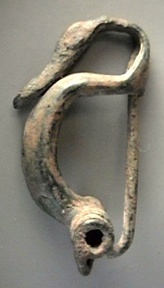
Early La Tène 1 brooch made near
Witry-lés-Reims,  Marne. 5th cent BC
My first Celtic brooch. In current coll. 

There are various dating conventions for early Celtic art: the commonest and what I will use here is 'La Tène’, named after a place in Switzerland where a large number of decorated objects were found. It does not mean that this site was the origin of the style and the sub-styles. This is further broken down into 'La Tène 1', 'La Tène 2', and 'La Tène 3' which are relative chronological divisions. Absolute dating is often omitted as the spread of early Celtic art was far from instantaneous: 'La Tène 1’ started in Britain much later than it did in the Rhineland. To complicate matters, there is also an 'early style' at the start of 'early Celtic art' which shows clear derivation from earlier forms, and where the La Tène style is just beginning to emerge.

Some areas within the broader Celtic world are devoid of La Tène art. It was most often (but not always) a decorative art applied to objects, and the catalogs of it are usually arranged by type of object, rather than by the development of the styles. The objects, themselves, might be native or derived from other cultural forms. Research is done, mostly, by tracking the designs or parts of them geographically and through time. The lack of decorated objects does not mean that there was a different culture living there. Simply put, it just means that those folks could not afford the finer things. Celtic culture, like many other primitive cultures, was hierarchical and had certain social conventions that determined how much luxury could be displayed. A prominent smith might also expect some land and perhaps tenant farmers and various other retainers. The great artists had warrior class patrons, so a lot of finer La Tène art is found on objects associated with warfare and feasting.
Snettisham style strap junction, East Anglia,
England, 2nd -1st cent BC. One of the nicest
known. In current coll.

In addition to the main La Tène styles, there are sub-styles that bear odd-sounding names: 'Waldalgesheim'; 'Hungarian sword style' (which does not even originate in Hungary); 'Plastic'; 'Disney'; 'Mirror', 'Snettisham', and so on. To describe all of these adequately would take a book!

This will be an ongoing series, so do come back for more. Remember, all of my own images are free to use for any purpose -- no credits required.

John Hooker

Left, Plastic style hinged anklet, Jacobsthal 267, Germany, 3rd cent. BC. Image adapted from Die Alterthümer unserer heidnischen Vorzeit. I scanned the source from the original plates and then played with it digitally. AuhV was one of Paul Jacobsthal's original sources for his Early Celtic Art, Oxford, 1944. The set is virtually impossible to obtain in the original. Thanks, again, Voz.

Sunday, 24 March 2013

Better to light a candle than curse the darkness

Anyone who knows me will be surprised to see this blog. I have long been critical of a number of blogs "The Usenet in a new suit", I have called them. So why this change? The post title says it all.

My name is John Hooker and I have researched, written and published on the ancient Celts, their coinage, religion and art for a very long time. My first publication was Notes on part of the Le Catillon hoard purchased by the Société Jersiaise in 1989 Ann. Bull. Soc. Jersiaise, 1993, 26 (1). I still have a number of off-prints -- would anyone like one? They say that an author's first publication is often worth more to a collector than subsequent publications. In my case, I am sure that this is not true. I would forgive anyone for not having read it, knowing what it was about, or even knowing that it was published in the Bailiwick of Jersey, in the Channel Islands (U.K.) 

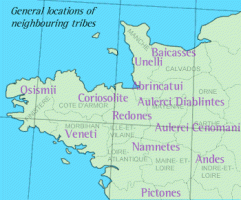
The article was about a hoard of coins, about 30% being of the Coriosolite tribe minted during Caesar's conquest of Gaul, but buried some time later. I compared the selection purchased by the Société  to the profile of the hoard, itself. Even back then, I thought that it was hardly worthwhile publishing anything unless you had something new to say. I had rather a lot of new information to show the world. For a start, not all of the coins that were believed to be Coriosolite were of that tribe -- they were of a tribe called the Unelli.  I also said that the hoards of coins found in Jersey were not buried by refugees fleeing from the Romans as was often (but not always) thought, but were essentially scrap metal buried after the war that was destined for recycling at Hengistbury, on the south coast of England.

I had created (1986) a new taxonomy separating the evolutionary changes from arbitrary changes in hundreds of design elements in the die creation and had plotted the former in a cladistic structure of flow-chart design, replacing the old system of die linking the die products which had used only a few arbitrarily chosen elements to establish a rudimentary and inaccurate classification system of six classes. The new system revealed three different issues, and hitherto unknown and occluded geographical details. Gilding the lily, I also broke them down into fifteen groups just for ease of identification and created a paper expert system by which a child could catalog any coin in a minute or two. Later (1996), I converted this to a web application complete with hyperlinks to essays about various themes at different stages of the system. A PhD student at Hofstra featured the latter in her thesis.

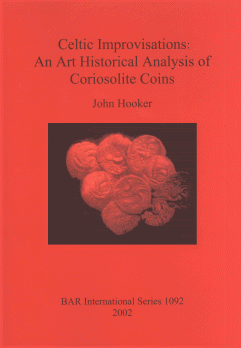
Nineteen years later, another hoard has been discovered, very close to the hoard I had written about in my first publication, and apparently of a similar composition. All of the reports, so far have again attributed the hoard to Coriosolites fleeing from Caesar's troops.  I was not the only person to suggest that Le Catillon was later than the Gallic war. Colin Haselgrove had also thought that it was post-Caesar in the late eighties, while I was researching and working on my manuscript: Celtic Improvisations: An Art Historical Analysis of Coriosolite Coins . Of course, my publication of 1989 was obscure, and Haselgrove was mainly working on the coins of S.E. England so it is little surprise that the idea had not spread far. After Spink turned down the manuscript because it was too specialized for commercial publication, I published it on the web, for free, in 2000.

Of course, there is a lot of nonsense on the web, and just because I had written something there, there is no reason that it should be taken at face value. However, almost at once, the web version was spotted by the archaeologist Sean Kingsley, who at that time was the managing editor for Minerva Magazine in London. He asked me to write a piece about my research and it was published as Celtic Improvisations: The Coins of the Coriosolites in volume 13 number 1 (2002). Being a commercial publication, it was not noticed by academia in general, and it was based on another hoard, so again, the information slipped by, unnoticed outside of the magazine's readership.

Sean told me that the book should really be in hard copy, and he made a couple of phone calls -- the outcome of which was that it was published, that very year, in British Archaeological Reports, BAR International Series (1092), Oxford. I was very happy about that as I had made great use of the BAR Series in my research. It contained top notch research and was commonly ordered, by subscription, by most university libraries. I only got ten copies for my efforts, but was happy to be in such good company. But, as books became more expensive, and the economy declined, most university libraries could not afford to subscribe to that series anymore and, instead, just ordered the titles that fitted with their own areas of interest.

Around that same time, I had designed the content, and my wife, Carin Perron (1957-2003) had built the very first Celtic Coin Index online using data from the Institute of Archaeology at Oxford. As Oxford did not pay for this, although they wanted the service and had promised grant money, it became my own property.

I was invited, by Professor Raimund Karl, to supply the entry for Celtic coinage in John Koch's five volume
Celtic Culture A Historical Encyclpaedia and this set was published in 2005. Being such a monumental work, the authors could not possibly be paid, but were able to buy the set at half price from the publisher.

I uploaded the hard copy version of Celtic Improvisations to Academia.edu, where it became a little more visible to the public as it was appearing on Google. Membership was free and the public could sign in as independent scholars. A number of people downloaded it, but even my local university library did not carry the actual hard copy on their shelves.

Rather than waste my time with further academic publications, which are useful to produce only for those within that system, but of no use at all to independent scholars, and the public at large, I thought it might be a nice idea to go directly to the public, so this blog will have current research that is ongoing, and will be about a number of topics. There will also be links to an e-book or two that I will publish at a price that anyone can afford; perhaps a few guest spots from the cream of academia, and elsewhere; good friends, anecdotes and issues far removed from Celtic coins and Celtic art-- artistic, environmental, social, and just mundane but interesting stuff. Something for everyone. You never know what, or who, you might encounter here. Perhaps this is the way of the future!

John Hooker