Thursday, 14 November 2013

Cultural frames and cultural property -- part six

United States Declaration of Independence
(1823 facsimile on vellum by
William J. Stone (1798-1865
)
 
In most of its applications, the term cultural property can be seen as illiterate, inaccurate, manipulative, or a legal convention. Whenever the term is used properly, the UNESCO cultural property conventions make sure that control of the object in question is transferred to the state.

If we use the term National Treasure, far fewer objects would be included but virtually no one would disagree with the term. This is not to say that there could be some grey areas as the term, in its practical application, would be a sliding scale. At the very top would be such objects as the United States Declaration of Independence. it is one of the most defining objects for the foundation of a contemporary state. In this sub-category, other countries declarations of independence would be included, along with such things as all original versions of the English Magna Carta and so on. Such objects are absolutely relevant to the foundation of modern nations.

A related, and laudable, designation is Living National Treasure, an honour bestowed upon individuals who embody intangible national cultural values. This designation was first implemented by Japan in 1950, and in Japan, currently includes an annual income for those individuals so designated which is more than $20,000 U.S. Groups are also included with different benefits being bestowed upon them. Other countries with similar honors have different reward systems of varying magnitude. UNESCO does provide guidelines for such programs. Again, very few people would disagree with such systems and the phrase "national cultural values" is valid as national culture is a completely valid cultural frame. Another example of something  that is truly an example of national culture is baseball which although evolving from earlier English games is, in its current form and name, an American invention. Basketball, too, can be included as an American invention. Even though its inventor was born in Canada, the game was invented in the U.S. In Canada, (ice) hockey is also an example of national culture. In Canada, it is simply "hockey" -- "field hockey" being a separate designation (and an English game).

We enter the grey areas of examples of national cultural objects with such things as the Elgin (or Parthenon) marbles. The arguments persist about rightful ownership. It can be said that Lord Elgin purchased them legally, but the seller was the Ottoman Turks who controlled Greece at the time. Soldiers who were prisoners on the island of Makronisos built small replicas of the Parthenon during the Greek Civil War (1946- 1949) proving the status of the monument as a national icon in modern times, yet Greece, much earlier, viewed itself as the rightful heirs to the Byzantine Empire, and at that time, the ancient Greek monuments were seen as representing an earlier paganism. The fall of Constantinople, to the Ottoman Turks in 1453 was the turning point in Greek national cultural identity and its reverberations are felt to this this very day. Modern Turkey has had great difficulty in defining its own national culture based on historical precedent because its area includes so many historical cultural groups. For more information on the nature of Greek national culture, I do not think that you could do better than to read Yannis Hamilakis, The Nation and its Ruins: Antiquity, Archaeology, and National Imagination in Greece (Classical Presences). The cover illustration shows prisoners at Makronisos building a small replica of the Parthenon. Hamilakis, in an admirably balanced view demonstrates that Greek national culture is both a top-down, and a bottom-up phenomenon.

So, while national cultural property is both valid and laudable, granting ownership of cultural objects to nations where such objects cannot be demonstrated to fall under the better term of  national treasures which reflect the Zeitgeist of the nation in question is both wrong and terribly harmful to the preservation of cultures. In fact, it is an example of a Jungian enantiodromia.

How are cultures propagated, studied and preserved? We can first eliminate nationalism in all cases where the above criteria of national culture are not met. We can also eliminate genetic inheritance for purely scientific reasons. My specialty is the ancient Celts, but my surname is one of the oldest English surnames on record dating back to 975 AD, the year that Edward the Martyr became king of England. My mother's maiden name was Neale, and that might be Celtic as it derives from the old Irish and Gaelic "Nial" which means "the Champion", but that has little do with genetic inheritance. As the ancient Celts were pre-Roman, it is more than likely that every modern European has some Celtic genetic ancestry, however indirect. The subject of early Celtic art was actually invented by Paul Jacobsthal who was a German Jew born in Berlin in 1880 and who escaped to England in 1937 to avoid persecution and (subsequent) possible death from the Nazis under the (non German-born) Adolf Hitler -- there's a bit of irony!

Josep Martí, in his paper on cultural frames clearly shows that culture resides in interest, and this is the free will of individuals, although this might be subverted by pornagraphic methods by business, or by totalitarian methods by nations, to mention just two ways, but the individual always has the final say. From my studies and my interest, I actually feel Celtic to a great degree, and for that I have to, ultimately, thank Paul Jacobsthal.

Tomorrow, lessons from Haida Gwaii


Wednesday, 13 November 2013

Cultural frames and cultural property -- part five


The photograph above is of a classroom at a business school in India. Can you spot the nonconformist? Look at how the colours of the decorative panels on the wall are reflected, not just in other aspects of the interior design, but also in the student's dress.

My wife worked as a substitute teacher when we first met, and she told me a story about a very memorable assignment. She had been called to work at a Jewish school and she heard that other substitute teachers were very reluctant to do so. This was not because of any anti semitism, it was just that most of her fellow substitute teachers found that assignment too chaotic. They liked to see their students sitting orderly at their desks, quietly waiting for their instruction, and then raising their hands to ask a question. Of course, at just about any high school, that is not typical of the scene that the substitute teacher encounters when entering the classroom, but Order is usually soon established.

So when she entered the classroom, she already knew what was awaiting her. In the Jewish school, the students were quick to interrupt the teacher if something was said that they did not agree with, and this often erupted into lively debate. The noise level was extreme, and she soon understood why the other substitute teachers avoided the assignment. But Carrie was adaptable and she loved it. She saw a greater level of enthusiasm for learning, and that learning was not just a single directional flow from teacher to student but a collaborative action -- the teacher was also in greater touch with the true feelings of the students about what was being taught. She was so enthused by the assignment that when our own daughter came of school age we tried to enter her at a Jewish school which allowed a certain number of non-Jewish students. Unfortunately, there were far more applicants than spaces available -- it had an excellent reputation, and our daughter did not get in.

Some years later, I was designing and producing emergency evacuation maps for worst-case scenario floods from dam breaches on two rivers in Alberta. In most similar cases, flood maps are "imposed" on those who might have need of them later, but I had decided that I really needed to know how my maps would be received and how problems with them could be resolved. In emergency situations, minutes can equate to lives and all actions must be calm and efficient. At first I thought that the maps must not produce too many questions as answering those questions would waste valuable time. I soon came to realize that this was wrong. Emergency workers are well-trained before any disaster takes place, so they are are already familiar with the maps. The Alberta government had decided that the previously-used evacuation maps were inadequate and were insisting on something better. Those maps had been produced by an international engineering company and their response was that they could not do any better. There had been some miscommunication -- the engineers knew that the data could not be improved, but the government's concerns were not with the accuracy of the flood levels (such things cannot be precisely predicted), but with the comprehensibility of the maps. Knowing that any flood levels would be variable, the engineering company had drawn them with a broad line. The maps had been produced by superimposing the flood levels over a photocopy of ordinary government maps.

I knew that the government maps had to be simplified and only essential information should be included. There would be no need to be aware of a picnic ground or ski slope half way up a mountain, but a locked gate on a forestry road certainly had to be clearly depicted. I also believed that the flood line should not be "fudged", but accurately depicted -- even though the computer-generated line was only an estimate -- floods carry a lot of solid material and this can produce "accidental dams" that affect the flow of water downstream. What is swept away, and what is not, cannot be predicted.

The first test was with dam workers at Ghost Dam on the Bow River. This dam produces electricity from its gigantic turbines and has a very large lake. It is fed from an even bigger lake and dam in the mountains -- Lake Minnewanka (that dam was critical in the recent Calgary area floods although most of the population did not know that). Being an earth-dam, it could not be allowed to overspill as subsequent erosion would then cause it to fail and that would have been a far greater tragedy.

I got the report from a presentation of one of my maps made to the dam workers. With the old maps, after a presentation, the workers were always asked if they had any questions. Almost always, there were not, and the presenter went away thinking that the presentation was a success. With my map, everything was different. Not only were there many questions, but lively debate also ensued --much like as it had at the Jewish school. What was really happening was that the earlier maps had been incomprehensible to most of the workers, and they had attributed that to their own failings, and not those of the engineers who had produced the maps. They had all gone to quiet, orderly, schools where no one stood out from the crowd. Each worker thought that he was the only one who did not understand, and as he did not want to be embarrassed, he kept quiet. The flaws in my own map were easy to understand, they were not mistakes per se -- it was just that the workers were more familiar with the actual terrain and saw where the maps did not reflect that properly. I was thus able to make the necessary adjustments like removing locations of gravel piles that had been depleted, and the workers were able to make different arrangements about locked gates and the like.

A very different scenario ensued at the First Nations Stony Reserve, on the other river, at Bighorn Dam. At that presentation, many of the resident just got up and walked out when they encountered something they could not understand. They knew that it was not their fault, but the fault of the maps or the presentation -- they were just wasting their time being there. They were not subject to the embarrassment factor prevalent with the dam workers at Ghost. There were major cultural differences between the two scenarios. It had been previously thought that the First Nations people could not understand maps very well, but that was just cultural prejudice -- they actually probably understood their own terrain better than the other dam workers who did not live on the same land - they knew the maps were no good.

When you read what UNESCO has to say about education, it all looks very reasonable -- at first. Then you encounter such things as IQ testing to eliminate students unsuitable for higher education. I suppose that if you were to submit IQ testing to Bushmen of the Kalahari, they might not score so well as the average high school student in a large city, but were you to take one of those students and drop them in the middle of the Kalahari, it would be unlikely that they would even be alive a week later -- unless they encountered a helpful Bushman.

In attempting to classify some Celtic coins, it did not take me very long to see a number of fatal flaws in classification, itself. Apparently, this realization did not happen with the folks who put together the UNESCO International Standard Classification of Education, or perhaps, if it did occur to one or two of them, nothing was said for fear of embarrassment for standing out in the crowd, or perhaps they just got up and walked out of the room, never to return. I wonder what this classification will look like in another ten years -- in typical bureaucratic fashion it will probably be even longer and with many more divisions. Bureaucracies do that sort of thing, they grow, cancer-like, until they collapse under their own weight, taking down the society that gave birth to them.

Learning, or acting upon, a classification system can be likened to building neural pathways in the brain -- like wagon ruts on an ancient road, they make travel easier along that route, but impossible anywhere nearby. As I constantly emphasize, variability and adaptability are essential for survival. All are equal in death. I will leave you with something I have given in an earlier post, but if you are not reading all the posts, you might well have missed it: it is Aaron Lynch's Units, events, and dynamics in the evolutionary epidemiology of ideas. Although much of it is too technical for most (myself included). Lynch presents enough for the average reader to grasp its essentials. The pertinent part being:

"Practical implications may follow from the above model of population creativity for ideas. For example, proposals to make education highly uniform and enforced by nationwide testing may tend to limit creativity by reducing the variability of combinations of important ideas. Creativity in an organization or a society might alternatively be enhanced by encouraging the acquisition of highly unusual combinations of ideas and fields of learning. Cultural, educational, and experiential diversity might turn out to increase population creativity by increasing the occurrence rates for extremely rare combinations of ideas that could lead to the formation of new ideas. In particular, this might result in higher creative output for universities, research institutions, and other organizations that deliberately strive for a culturally diverse mix of people. Yet even a 1000-fold increase for an idea combination that exists at a prevalence of 10-9 only involves one person in a million, representing only a tiny dent in the prevalence for extremely common combinations of ideas that would form the mainstream of a society or a subculture. Factors such as that might even be investigated as sources of different creativity rates in different countries. Such practical implications also warrant separate papers in their own right. The focus here is on the role of quantitative processes in a population affecting population creativity, and thus the evolution of ideas."

Tuesday, 12 November 2013

Cultural frames and cultural property -- part four

George Orwell
At the start of the final chapter of Archaeology Under Dictatorship, Michael L. Galaty and Charles Watkinson (editors), New York, 2004, Bettina Arnold says:
While compromise is an inescapable aspect of life, it can constrain activity to the point where the basic tenets of a discipline are undermined, requiring the practitioner to choose between prescribed practice and professional survival. This occurs on a kind of sliding scale in all modern nation-states engaged in archaeological research, but is particularly marked in dictatorships, in which the operating principle is that the state determines the scope and the focus of the production and dissemination of knowledge about the archaeological past.
The book contains a broad selection of ways in which the interests of  dictatorships have been served through archaeology, for example, archaeology in Libya under Mussolini was only interested in the Roman period: the Fascists wanted to portray themselves as the "new Romans" and by doing so, not only justified conquest but glorified it. yet the Roman model also served Napoleon and the French Revolution had more than a slight effect on the American Revolution. To this day, Roman iconography and other allusions are core in the U.S. It is clear that it is not so much what is emphasized, as how it is emphasized: we can say, with equal truth, that the Romans brought other cultures under their yoke, and that they brought civilization and order to barbarism. The connecting quality being "greatness".

While the theme of the above book is dictatorships, we cannot accurately describe the phenomenon as "archaeology under dictatorship" as a theme and all other state archaeology as unique examples. Another theme: archaeology under communism was the subject of TAG2010: the 32nd annual meeting of the Theoretical Archaeology Group. Nor do we have to restrain ourselves to political theories for a theme, I often encounter "modern archaeology" compared to "mere nineteenth century antiquarianism".

The archaeological and historical past are the brushes, paints and canvas used to create any picture we choose. It can be the source of great fun for all, and it only becomes insidious when we attach to it claims of being "scientific", "objective" "official" or "moral".  So designated, it can be used to bully, coerce and capture the minds of people for ulterior motives. It thus ceases to be pure art and becomes, instead didactic.

In Mythic Worlds, Modern Words: Joseph Campbell on the Art of James Joyce (The Collected Works of Joseph Campbell) we read (p.21):
Pornagraphic art is art that excites desire, It is not proper art. If you see a picture of a dear old lady, for example, and you think, "What a lovely old soul! I'd love to have a cup of tea with her" -- that is pornography. You are exciting desire for a relationship to the object. Or you open a magazine and see a picture of a refrigerator and a beautiful girl standing beside it and smiling, and you think, "I would love to have a refrigerator like that." This is not art, Joyce says, it is pornography. ... Another type of improper art is art critical of society, art in the service of sociology. Such art excites loathing, and Joyce calls it "didactic art." Those who produce such art I call "didactic pornographers."
In an earlier post, I told of my realization that all classifications are subjective, and while the objective existence of a series of coins can be easily proven, attempts to classify specimens in groups must always be subjective. There is the whole and then there are individual examples. We can extend this to culture. To be precise, we can say that the word can be defined, and it is something that is expressed by all human beings, yet as soon as we decide to subdivide culture we can only objectively do so by presenting each individual. To be practical, however, we have to attempt some sort of classification and that is quite alright providing that we make no claims about their existence as an objective reality. Martí's ideas about cultural frames preserves the honesty of the objective method as we can find no two people who share, exactly, the same set of cultural frames.

The most subjective and unscientific expression of culture is that of a nation. UNESCO takes it one step further by trying to unite separate nations with singular agreements concerning the components of culture and the individual is thus utterly negated.. We can, of course, objectively prove that individuals do exist as no two people share the same dna. If we attempt to circumvent this situation by defining any living entity as a set of genes, then it is possible to find applications in this genetic make-up, but we run the great risk of disaster because nature is so much more. Unfortunately, our errors do not come to light until after the fact. The success and survival of anything depends on diversity, so when I hear of the possibility that agreements about cultural property as defined by nationalism are dependent on agreements about genetic modification, I see only extinctions. But cheer up, life will persist! It does not have to be human, but it will always consist of individuals.

Tomorrow: How UNESCO can prevent the advancement of our species through education.

Monday, 11 November 2013

Cultural frames and cultural property -- part three

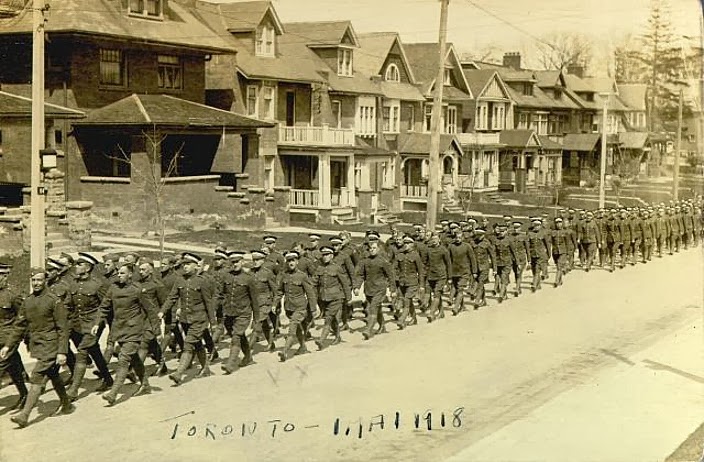
Royal Flying Corps, marching in Toronto, Canada
1st May 1918
In many countries, and under different names, today is Remembrance Day. Although now applied to remember those of the armed forces who were killed in all military conflicts, it originated as a response to World War I. In 1914, H. G. Wells published a book entitled The War That Will End War. Even at the time, the title met with some skepticism, but it captured the public imagination over the following few years, especially because of the dreadful loss of life for so little advantage. It epitomized the Pyrrhic Victory.

A young person, today, might be forgiven for misunderstanding the symbolism in the Remembrance Day events. While being a tribute to those soldiers who fell, are we supposed to envision some sort of glory in their deaths? Certainly, during and after World War I, it was widely understood that there was no longer any glory in a war where thousands were killed over a piece of ground that had been a market garden (Ypres). How many people, today, have learned the lesson that H.G. Wells wrote in that book (p.16):
But be it remembered that Europe's quarrel is with the German State, not with the German people; with a system, and not with a race.
But could the desire to end wars also lead to another sort of Pyrrhic victory? let us return the theme that I started yesterday, an analysis of some of the points in UNESCO its Purpose and its Philosophy, by Julian Huxley, 1946. Let us look at another passage:
The moral for Unesco is clear. The task laid upon it of promoting peace and security can never be wholly realised through the means assigned to it -- education, science and culture. It must envisage some form of world political unity, whether through a single world government or otherwise, as the only certain means for avoiding war.
Is this not a bit like saying that the best solution to avoid strikes and other forms of labor unrest would be slavery or totalitarianism? In the Wikipedia entry for the causes of World War I we read: "Militarism, alliances, imperialism, and nationalism played major roles in the conflict as well." Yet, the very nature of all of the various UNESCO conventions about cultural property revolves around alliances and nationalisms.

Pursuant to the UNESCO cultural property conventions, are the U.S. Memoranda of Understanding (MoU) about the importation of objects designated as "cultural property" into the U.S. These are deals arranged between the U.S. State Department and foreign nations by which bans are imposed by the U.S. on the importation of  certain classes of objects (without an export permit -- which is often impossible to obtain) in return for concessions paid to the U.S. by the nations in question. While the American people are informed of what they must forgo in importation rights, they are not informed of what these countries have agreed upon as a quid pro quo. In fact, that side of the deal is a State Secret and not even obtainable (so far) through legal actions. An illusion of democracy is maintained by allowing the public to voice their concerns, agreement, or disagreement with the proposed MoU through messages that are published on the web, yet it is only one side of the deal which is revealed. It is thus very possible, and in the light of the secrecy component, highly likely that many Americans in favor of the MoU would not be so favorable if they knew all of the details. So far, there has not been a single incidence of where the public were overwhelmingly against a particular cultural property MoU and it was subsequently dropped, so the problem is moot. It is only an apparency, and thus a mockery, of the democratic process.

For about three years, I did some voluntary work for the Ancient Coin Collectors Guild which included encouraging public responses and aiding those with questions about various MoU's which included ancient coins. No other collecting area was similarly represented by any organizations or individuals because advances in numismatics are overwhelmingly due to the work of independent scholars. The subject is so complex, and so interdisciplinary, that it cannot be successfully taught during the time allowed for a university education. I have told many people that I think that it takes at least twenty years to become proficient enough in the subject to make real contributions to its methods. Because of the nature of the subject, these methods are often unique to a study in question. There is little "one size fits all" methodology beyond simple die-linking and, as I have proven in my own work, the usefulness of that is limited. Anyone who has read my blog for some time will realize that the number of subjects I have used in my research are many.

Over a number of MoU processes, I heard things about, and did further research on, the subject of what secret concessions were granted to the U.S. in return for their imposition of import restrictions. Interestingly, only two possibilities surfaced: the establishment of military bases and concessions to the Monsanto Corporation. The first was an expected response -- almost part of  the mythology about the U.S. The second was due to actual observations and known data -- Hillary Clinton was the Secretary of State at the time and if you want to make up your own mind, then simply Google Hillary Clinton Monsanto.

So, we have seen two of the assigned causes of World War I (alliances and nationalism) also absorbed by the UNESCO cultural property conventions, and the other two (militarism and imperialism) absorbed by the perceived quid pro quos in the U.S. cultural property MoU processes. Of course, the latter depends on much speculation because its secrecy allows only for speculation. Yet, it is very clear that these two are the only answers voiced by the American public and are thus indicative of their main concerns. You would think that the U. S. government would be swift to reveal the second half of the deal knowing, as they must, this aspect of public opinion if neither were true. The only other explanation is that the real quid pro quos are so horrible that they have not even been imagined by members of the public.

After banging my head against the wall for three years, I came to the conclusion that public opinion could not possibly sway the U.S. State Department, and instead, I decided to start this blog to show the more positive side of amateur research. This current series, however, contains a crossover between the two, and this particular post is the only one where it will show up. I thought it pertinent to Remembrance Day as during those three years, "war" and "battle" were the dominant metaphors that I had encountered. Tomorrow, we will start to look into the ways that nationalism and the past has been used to influence people's thinking to the benefit of certain politicians and leaders.

Friday, 8 November 2013

Cultural frames and cultural property -- part two

Wikimedia Commons public domain image
The past of any given geographical area is like an artist's palette: each dab of colour on the palette can be combined with others to create any colour that could be imagined. The choice is up to the artist. With light waves, red, green and blue can be similarly combined, and in computer applications we can create 6.7 million colours -- more than the human eye can differentiate, from those same three colours. The dna molecule has only four components, and yet no two people have the same dna. Do you think that nature is trying to tell us something?

Animals with lower genetic variability have less survival potential. The African cheetahs are almost clones and are endangered, the largest population (about 2,500 individual) is in Namibia. The Asiatic subspecies is in even greater trouble -- only 50 to 60 individuals remaining in Iran (see here). Yet, we are living in an age where the current power-bases are stressing monopolies, monoculture and immediate gratification in all things. We are actually trying to become extinct as a species.

In cultural matters, the current power-base is UNESCO. If you have the stomach for it then read the online PDF: UNESCO its Purpose and its Philosophy, by Julian Huxley, 1946. Huxley was its first director. It starts out very positively does it not? Read on, or, if you are short of time then search the page for "eugenics" -- there are seven occurrences. Here's a gem:
It is, however, essential that eugenics should be brought entirely within the borders of science, for, as already indicated, in the not very remote future the problem of improving the average quality of human beings is likely to become urgent; and this can only be accomplished by applying the findings of a truly scientific eugenics.
That the above could have been published so soon after Hitler's goals of world domination and the creation of a Master Race were dashed, really boggles the mind. Everyone knows about the Holocaust, fewer know that the same treatment was given to the Romani. But the evil did not stop with eugenics -- anything that offended Hitler's personal vision also had to go, and that included intellectuals, homosexuals, swing dancing and modern art.

It was in 1971 that my friend Bryan and me set the ball rolling that put an end to eugenics here in Alberta. I wish I could tell you that our motives were noble, but that is a story that must wait for some other time. It was prior to the provincial election and we attended a public address by the leaders of each party. We came with a plan and a question. It seemed that Peter Lougheed would win the election. I noticed that he would answer all questions directly and head-on -- strange behavior for a politician, I thought. He was going to be my target. When it came to questions from the floor, I stood up and asked him if he had any plans to put an end to the compulsory sterilization of patients in mental hospitals in Alberta -- a fact that had been recently reported in the London Times.

He had been sitting with his hands clasped behind his head and the front legs of his chair were off the floor. He seemed to be very pleased with the proceedings so far, as well he should have. When he heard my question, the chair almost fell backwards. He regained his balance and told me, in a typically political manner, that it was something that he was definitely going to look into very thoroughly. Bryan was strategically positioned near the stage, and afterward told me that Peter had asked his research assistant if he knew anything about this sterilization business. The young man replied that he thought that "they were just locked up". Peter asked him for a report on the matter and gave him a week to complete it. We met Peter Lougheed afterward, and he invited us to an upcoming convention in Edmonton. We attended of course, and spent some time talking with his research assistant in their reception suite at the hotel after the event.

Peter Lougheed won the election, appointed the right people for the task and even helped one of the sterilization victims, himself. The rest is history. The victims received the largest compensation ever paid out in the Province of Alberta, and eugenics was ended here. I generally don't think much good of politicians, Peter Lougheed was one of the few exceptions.

On Monday, we will look at some other aspects of the UNESCO document.

Thursday, 7 November 2013

Cultural frames and cultural property -- part one

Coca-Cola bottle in China
Photo: 
Anna Frodesiak
One of my favorite papers is The Cultural Frames Approach as an Alternative View to the Ethnocratic Idea of Culture, by Josep Martí, Spanish Council for Scientific Research (CSIC), Barcelona. I came across it when I was looking into the idea of the term cultural property as a pernicious euphemism. The term cultural property is a modern concoction which, in its popular understanding, replaces national treasure. In the application of so-called "cultural property laws", only national interests are represented so we cannot even label them as ethnocentric. Ethnicity as a sub-group of a nation is expressed no better than in the case of Papua New Guinea where it "is estimated that more than 7000 different cultural groups exist" most of them having their own language. Martí's paper shows that, even within a far more homogenous society, the actual numbers of "cultural frames" are almost infinite. He says:
"Moreover it is obvious that within the same country we will never find two persons, who according to these criteria, respond to the same cultural definition."
I first came to this sort of realization in my attempts to reclassify the coinage of the Armorican Celtic Coriosolite tribe (Britanny). Numismatic classification is based mainly on design features and not so much on "official" reductions in their intrinsic value. In the case of Coriosolite coins, there was a 25% reduction in the intended amount of silver in each coin at one mint, yet the previously designated classes were defined only by design features. I came to the realization that the objective design designations could first be represented by series, and then by individual examples. There were no classes within a series that were not subjective. Thus any attempts to perform statistical analyses of the coinage by using classes were essentially useless. In turn, this led me to a very critical opinion of the subject of classification, itself -- I was looking for defined groups, but could find only individuals. I did break the previous six classes of Coriosolite coins into fifteen groups, but made it very clear that these groups were only useful for an approximate idea of where a coin fitted into the chronology of each mint and could not be used for any other purpose.

This realization became reinforced when I read Michel Foucault's The Order of Things: An Archaeology of the Human Sciences in the preface of which he gives the following taxonomy of animals, supposedly, from an old Chinese encyclopaedia:
(a) belonging to the emperor
(b) embalmed
(c) tame
(d) sucking pigs
(e) sirens
(f) fabulous
(g) stray dogs
(h) included in the present classification
(i) frenzied
(j) innumerable
(k) drawn with a very fine camelhair brush
(l) et cetera
(m) having just broken the water pitcher
(n) that from along way off look like flies
The verity of the passage is unimportant. Instead, it serves as a reductio ad absurdum to illustrate Foucault's ideas about classification. We cannot be sure whether Foucault either knew or cared about the authenticity of the passage's attribution. I quoted it in a discussion where I offered a classification of the term Celtic on the Celtic-L discussion group  and was delighted to receive this reply from the political scientist Professor Bruce E. Wright which illustrates most of the above topics far better than any example I could offer.

Tomorrow, we will start to look at the dark side: the nature of the "pernicious euphemism" that is cultural property and why it is not merely an example of modern illiteracy.

Wednesday, 6 November 2013

TV or not TV?

I bought my current television set only a few years ago. Unlike the one illustrated here it was colour, of course, and had push buttons instead of dials. But it was still the old "tube type" -- about as deep as it was wide and with no sound controls other than volume. Unlike most of my friends, I was never very interested in gigantic screens, so it has a twenty inch screen. With a fixed screen resolution, the picture looks better on a smaller screen and I have always felt that if a television set is the most dominant object in your home then it says something sad about your importances in life. The store where I bought the TV set no longers sells the old type.

There is something unrealistic about watching almost any TV show (apart from the content) -- the sound is unnatural and the colours are over-saturated. The problem with the colour can be easily rectified, but not so the sound. Producers of television shows feel that the human voice is not mellifluous enough, and my worsening hearing does not do well in the lower registers -- there are some shows that I do not watch at all because the sound is so bad. I found, though, that if I watched them online there was no problem -- I can do all sorts of things with my computer's sound. Of course, I could buy an expensive sound system and then a new TV set and connect everything together to get the same effect as I get on my computer right now. About the only advantage to this, as far as I can see, would be the ability to brag about my new system -- but I'm not that sort of person.

Little by little, I am seeing other advantages to watching TV shows online: I can watch whatever and whenever I want. As I also have a Netflix account, I can watch entire series from start to finish whenever I choose to do so, so I am not restricted to TV schedules or just the previous few episodes on the TV network and channel sites. I can pause a show for as long as I like -- even days, and the site remembers my place the next time I log on..

One of the greatest things about not watching TV, for me, is that I am not subjected to "News Breaks". I do not watch TV news, I never read newspapers or listen to the news on the radio. If I want to learn something about what is going on in the world I will Google it. If there is some important event happening somewhere, people will be talking about it and I can decide whether or not to look into the matter further. Yet I am still subjected to newspaper vending boxes displaying headlines like "2 year old plunges to death from balcony".  If this is what makes people buy newspapers there must be something severely wrong with them. To me, pornography would be less offensive -- in fact I look at news as just another form of pornography. I do subscribe to certain types of Internet news -- for example "tech news" -- which contains no stories of death dismemberment and other human tragedy, but lets me know of advances that might interest me. I do like to follow important natural disasters, not for the sensation, but because I had worked in that area -- I created emergency flood evacuation maps. I also know a little about such things as dam repair. During Hurricane Katrina I watched, on TV, troops trying to shore up a levee. I thought, "You can't do it that way, it won't hold!" two seconds later, the whole thing collapsed and the water came flooding in.

Sensation is a drug that not only creates addiction, but like many other drugs it requires more and more to get that "high". If people want to subject themselves to such things, that is their business. I will often advise against certain things, or offer some constructive help with a problem, but if the person does not want to listen, or prefers to do something different -- that is up to them. The problem with modern sensation-pushing is that it desensitizes people to things that we really should be concerned about -- what sort of world are we creating for our grandchildren? Not only that, but sociopaths and terrorists have to do ever more horrendous things to get attention. TV is their enabler.

Setting aside all of these social issues, it also occurs to me that I am wasting my own resources: like many people, I bought a package deal from my service provider: TV, Internet and phone. I had switched to a cable company because of severe ethical issues with the phone company I had previously used. While I am very happy with the new service, I will probably just drop the TV service at the end of my contract. The TV set will go the recycling depot.


Tuesday, 5 November 2013

British Celtic anthropomorphic sword pommel

British Celtic anthropomorphic sword pommel,
ca. late 2nd cent BC. height 23 mm. front view
This anthropomorphic sword pommel is in typically British style with the hair represented by straight lines, and a simple line for the mouth. The eye sockets are drilled, and were perhaps originally filled with red enamel. Both sides are recessed where the arms would fit, and another drilled hole above one of the recessed sides was likely for a knop to better secure the pommel. On the base, there is another drilled hole in the centre to accommodate the end of the tang and this is surrounded by two recessed and rounded channels in the form of a cross which gives the appearance of a Philips type screw-head. However, the fore to aft channel is shallowly cut, while the side to side channel is deeper.

The elaborate securing mechanisms were needed because the Celts could neither solder nor weld and swords frequently lost their pommels through accident. The effort was to no avail, of course, it was still lost from its sword.


The closest parallel, and believed to have been manufactured on the continent, is Jope Plate 132 a-g from North Grimston Yorks, where the arms, like on this one, rest tight against the head in a similar manner to the second illustration on the left. the angle of the arms is different, though, more closely resembling the third illustration but set higher. Another British example, the third illustration, is from "Yorkshire" (Jope Plate 133 h.)

Other views of the pommel follow (click on them to enlarge)


Monday, 4 November 2013

Accessing C. G. Jung 7. Becoming a Jungian analyst

Image:  Rajeshodayanchal, 
Becoming a clinical psychologist is not going to be easy. You would usually need a degree in psychology with a fairly high average before even being considered for a clinical degree program. However, such an educational route is much like any other field -- you can leave high school, apply for a university degree program in psychology and go on from there. As an example, here are the requirements from my local university. You will not see anything much different from the requirements of advanced levels in many other fields.

In comparison, now look at the PDF brochure for the  International Training Program at the C. G. Jung Institut Zürich. For a start, even being admitted carries the following requirements:

"Those applying for the training must be at least 25 years of age and must be able to provide evidence of having graduated from a university or university of applied sciences as well as 50 hours of self-experience in analytical psychology."
In other words, don't even think about analyzing others if you have not been analyzed, yourself. I dare say that the thought of undergoing analysis, oneself, does not even cross the minds of most students applying for other degree programs in psychology. If you pass the admission requirements, 300 more hours of being analyzed forms the core of the program. In addition to that, and the study programs, there is also an internship requirement -- "at least 12 weeks of 40 hours per week, part-time internships last correspondingly longer."

With the regular universities, the clinical practitioner programs require a pre-requisite degree in psychology, but at the Jung Institut the degree requirements are broader -- but, as we have seen in this series, Jungian psychology is not restricted to the cure of neuroses and psychoses, but is used by mythologists and novelists, and can be applied to just about any discipline -- Jung's own major development of his theories came from the subject of alchemy! No subjects are exempt from a Jungian approach -- there is even some crossover to quantum physics, postmodernism and transdisciplinarity.

Yet the subject of Jung is mainly treated as "historical" in most university programs in psychology. One might well speculate (perhaps cynically) on why this should be so.

Friday, 1 November 2013

Accessing C. G. Jung 6(c). The contextual archaeology of symbols

Hut figure, rock 73 in Naquane area. Capo di Ponte,
(Val Camonica) Italy.
The mythological use of Jungian archetypes is dependent on surviving narratives, or a combination of symbols represented by a culture with no surviving narratives that can be favorably compared with a set of symbols from another culture which refer to a known narrative. We cannot usually reach a missing narrative through a single example of any symbol, and the more comparable symbols at a single site to a known narrative from another site (even where there can have been no direct communication) then the greater the certainty can be about the shared meaning. This lack of communication need not alarm us as symbols are visual metaphors and the choice of a particular symbol says something about its inherent qualities.

In The Role of the Boar in Celtic Iconography and Myth I compared the myth of Meleager and the Calydonian Boar with the Irish epic story of Diarmait and the Boar of Benn Gulbain, but also added:
"Joseph Campbell tells of the Malekulans in Melanesia, where boars are sacrificed at Megalithic shrines as a payment enabling one to enter the Otherworld at death. The association of pigs, and especially boars, with the underworld, night, and death is almost universal. As animals that root in the ground, that are often dark in colour, that have tusks shaped like the crescent moon, and that are ferocious, it would be odd for them to have any other meaning."
While the purpose of myths is not to explain nature and cosmology, the use of such as metaphors for various aspects of the human condition is universal. Both of the myths in the article were, to a great degree, a telling of the hero's journey -- a Jungian subject that interested Campbell greatly. In fact, one of his most popular works is The Hero with a Thousand Faces (The Collected Works of Joseph Campbell). The title refers to the universality of the theme.

But there is another source of symbols: images that are generated in the mind and then associated with a theme after the fact. Included in this category is the work of  J. David Lewis-Williams on rock art: A Cosmos in Stone: Interpreting Religion and Society Through Rock Art (Archaeology of Religion) in which he focuses on the San (bushmen) of southern Africa. Lewis-Williams attributes the source of these symbols to images generated in the brain and optic nerves in various altered mental states (entoptic phenomena). This sort of imagery has also been applied to ancient Celtic iconography and perhaps has contributed to the association of Druidic practices with shamanism among some people. The problem is that through syncretism, over many generations, images that might have first been experienced as entoptic, were then associated with a quality. The knowledge of the source of the image can soon be lost, but as the quality always refers to a human and psychological condition, the metaphor can survive even changes in the mythological narrative as it passes from one culture to another. Thus merely identifying a symbol as having an entoptic source does not mean that the symbol in any given cultural application is directly generated as an entoptic image within the practices of that culture.

So what happens when we see and can identify something as a symbol, yet have no corresponding and connecting mythology? The mere fact of our identification of something as symbolic then generates an appropriate meaning that is part of our own mythology. I think that this is what happened in the coin and LSD art figure in Man and his Symbols. The myth that the images generated in the writer's mind were of the contemporary worries about the fragmentation of society. It is also very interesting that the caption writer also failed to identify the exact nature of those images: not only were the coins misidentified, but so were their connections. A further separation from reality was the missing description from the artist about their thoughts while drawing under the influence of LSD-25. It seems most likely to me that these errors were an unconscious expression of the disconnection with reality. I am reminded of a story I was told about a strange sighting in the sky: some people claimed to have seen a flying saucer, while the Roman Catholic observers of the same phenomenon reported seeing an image of the Virgin Mary in the sky.