A panorama of the view from where the sweetgrass braid was spotted. The image was mosaiced together from many shots with the distortions corrected, a technique commonly applied to aerial photographs in cartography
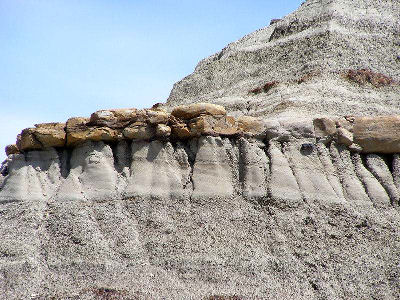
A typical formation at Dinosaur Provincial Park
Just 48 km northeast of Brooks, Alberta lies the world's richest deposits of dinosaur bones at Dinosaur Provincial Park. There, one can find more than 80 square km of strange-looking geological formations, wildlife, and plants that most foreign visitors would not usually associate with Canada -- like the prickly pear cactus, for example. In some instances, the smell of sagebrush fills the air. Fossils are everywhere to be seen: in the rocks, in special displays, as the remains of ancient trees on the canyon floors -- even what might seem at first glance as just gravel and small stones can contain tiny pieces of fossilized dinosaur tendons, claws and teeth. The park occupies just one part of the vast Badlands of the Alberta prairies. Of course, you are not allowed to gather these fossil remains and take them home with you, and important fossil discoveries should be reported to the staff at the park. The landscape changes and new deposits are often revealed.
A cactus in flower near the sweetgrass braid
The main road into the park has various places where you park your car and take photographs of badlands that seem to stretch to the horizon -an alien landscape carved out of the flat prairies by millions of years of erosion. In one of these rest spots is the evidence of much later visitors to the area. Surrounded by a steel pipe fence just high enough to prevent car wheels from disturbing it is a tipi ring -- worn stones left by the retreating glaciers of the last Ice Age that the First Nations people gathered and used to weight down the sides of their tipis. By the geological standards of the area, these are modern. Yet these stones are partially buried in the ground at a depth that suggested to me that the tipi was here long before the white man first arrived in the area.
The sweetgrass braid in the centre of a tipi ring
In the middle of the tipi ring, I spotted something even more recent -- it was a massive braid of sweetgrass, a sacred plant to the Plains Indians, it was used in ceremonies and rites, in healings and to respect the land and all that it contained. "New Ager's" use it as well, and I often burn it at home too -- just for its pleasant aroma. You can buy small braids in shops here, for about $7.50. What I saw in plain view in that tipi ring was not a commercial braid, though. It was far too large. Such a braid would cost more than $50 in a shop, but such braids are not sold. I cannot say for sure that it had been placed there by a member of the First Nations, but it seems very likely. From its condition, it could not have been placed in that spot more than just a few months earlier. It had obviously never experienced a Canadian winter!
Even such a common plant as the thistle can
take on an alien look in such an environment
The tipi ring, itself, was in an odd location. On its own, it was positioned just a few metres from the edge of a cliff. It was certainly not part of a camp -- any sleepwalker might have come to a dramatic end within seconds of leaving that tipi! It might have been a lookout point, or perhaps it had a sacred function in the past. It certainly had one in the present as the sweetgrass braid attested.
One of the long-term residents of the park
The fact that many visitors to that parking area must have seen it and yet no one took it, says something about our encounters with the sacred as expressions of other cultures. Canada, of course, is multicultural. We are famous for the respect we give to other cultures and people who arrive here from less tolerant places are always amazed at the friendliness of their new neighbours toward them. Of course, there can always be a few exceptions, but the overall response is overwhelmingly friendly. As a nation, we do not admire racist feelings in any form, and NATO has long used Canadian troops as peacekeepers. Canadians are known to be friendly and polite. I once heard a story about a very perceptive police detective in Los Angeles. A woman was found wandering around suffering from total amnesia. After checking missing person reports, the police were no closer to discovering her identity, when this detective noticed that she was exceptionally polite. He reasoned from this that she had to be Canadian! Shortly after contacting the RCMP in Canada she was on her way back home to her friends and relatives. I don't know if the story is true or if it is an urban myth.
An ancient cottonwood in the park
It was strange that the tipi ring was in that spot. It was also strange that there was a modern sweetgrass braid in the centre of the ring. What was not strange, however, was that no one had taken it away.
There are a few field archaeologists who think that they understand context, but who really do not, and who look down their noses at people who study objects instead of archaeological sites. An object is simply something that is designated to be so. Ironically, such designations are not objective -- they are subjective. The subject is the observer. To find a pure object, you would have to go way down to the sub-atomic level -- and even then, a physicist in the future might break that down further as they did, long ago, to atoms.
It is not unusual to find a complete object, such as a coin, which has suffered very little damage since it was made. It might have some light corrosion, and its microscopic structure will have changed somewhat, but it will have all of its parts. These parts are the motifs and the design elements that they are comprised of. None of them have rotted away, or have been rearranged through disturbances in the ground. No one removes the head of an emperor from a coin before abandoning it. An archaeological site, however, has usually had things like that happen to it over the years. Even Pompeii, covered in the ash of a volcano, is still not pristine. Not only has the flesh of the bodies vanished, but also the bodies, themselves are found in contexts related to that event, and not to their daily routine.
A work of early Celtic art has its parts arranged in a special way, by its creator. Those parts consist of other parts -- the design elements. Through the contextual study of all of these, we can do many things. We might even identify specific individuals, and through seeing how they developed their work through a series of these objects, even come to know what, and how they thought, the speed of their production, the tenets of their art and the attitudes that they brought to the work. We might discover volumes about their religion and their politics, about their economy relative to their neighbours; we could track all of these influences through space and time to their origins. Virtually no archaeological site could yield so much information. Many archaeological sites have to be grouped together to even begin to understand much at all. In such cases the object becomes 'storage pits', graves of a certain culture, 'watery deposits' hoards, and much more.
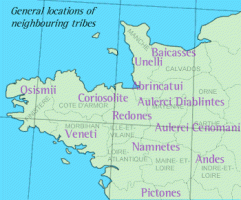
Precise chronology of the same motif in a series of Coriosolite coin dies from Côtes-d'Armor. 57/56 BC. The order is confirmed by several other motifs with overlapping changes.
The archaeological record is not objective either, it is created in the mind of the archaeologist from remains of the past combined with his or her education, experiences, and psychology. It is a combination of all of these things. Even the objects, themselves, and their parts are subject to this filtering.
Finally, while find spots can tell us a lot about humble objects, high status objects usually traveled far, through gifting, trade, war booty and recycling. In every serious work on British Celtic art, the lack of archaeological contexts is explained at the very outset. What little information we have about find spots is corrupted by insistence on proper recording at a level higher than voluntary. That is when people make things up. The records then become useless.
This is an ongoing series, so do come back for more. Remember, all of my own images are free to use for any purpose -- no credits required.
I have collected early Celtic art for more than twenty-five years. It is a slow process. Throughout this blog, I will illustrate pieces from my own collection, some of which I retain, some that I have sold in order to buy new pieces, and some illustrations will be from other sources. The status of the object will be mentioned in the post, but that could change at any time. This is not a sales list. Of course, I will not live forever, so various pieces might move to other collections, public or private. For important pieces, I would prefer that they go to a public collection, especially if they will be on display, but the final decision will be made by my heirs. If you are a curator reading this blog and feel that something should be in your collection, then by all means, contact me at john[at] writer2001.com, and I will pass your message along to my heirs, together with any recommendations I have. This will make things simpler for them. The same will go for other objects other than the Celtic that might appear here from time to time. Anything that has a photo credit attached to the picture, and any accompanying illustrations, of course, are exempt from this. Most of these will already be in museums!
Lets start with the basics: the proper term is 'early Celtic art', it is not 'early pre-Roman European Iron Age art' and certainly not 'early "Celtic" art', or the even more absurd, 'early "Celtic" "art"'. The use of such scare quotes is faddish, short-lived, and says more about the ignorance of the writer than anything else. All of the standard works have, and always will, use 'early Celtic art' in the titles. If the works also contain things like Romano-Celtic art, Medieval Irish art and various Celtic revivals etc., the term will be simply 'Celtic art'.
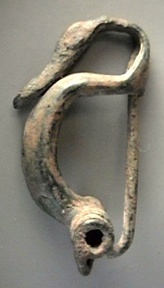
Early La Tène 1 brooch made near
Witry-lés-Reims, Marne. 5th cent BC
My first Celtic brooch. In current coll.
There are various dating conventions for early Celtic art: the commonest and what I will use here is 'La Tène’, named after a place in Switzerland where a large number of decorated objects were found. It does not mean that this site was the origin of the style and the sub-styles. This is further broken down into 'La Tène 1', 'La Tène 2', and 'La Tène 3' which are relative chronological divisions. Absolute dating is often omitted as the spread of early Celtic art was far from instantaneous: 'La Tène 1’ started in Britain much later than it did in the Rhineland. To complicate matters, there is also an 'early style' at the start of 'early Celtic art' which shows clear derivation from earlier forms, and where the La Tène style is just beginning to emerge.
Some areas within the broader Celtic world are devoid of La Tène art. It was most often (but not always) a decorative art applied to objects, and the catalogs of it are usually arranged by type of object, rather than by the development of the styles. The objects, themselves, might be native or derived from other cultural forms. Research is done, mostly, by tracking the designs or parts of them geographically and through time. The lack of decorated objects does not mean that there was a different culture living there. Simply put, it just means that those folks could not afford the finer things. Celtic culture, like many other primitive cultures, was hierarchical and had certain social conventions that determined how much luxury could be displayed. A prominent smith might also expect some land and perhaps tenant farmers and various other retainers. The great artists had warrior class patrons, so a lot of finer La Tène art is found on objects associated with warfare and feasting.
Snettisham style strap junction, East Anglia,
England, 2nd -1st cent BC. One of the nicest
known. In current coll.
In addition to the main La Tène styles, there are sub-styles that bear odd-sounding names: 'Waldalgesheim'; 'Hungarian sword style' (which does not even originate in Hungary); 'Plastic'; 'Disney'; 'Mirror', 'Snettisham', and so on. To describe all of these adequately would take a book!
This will be an ongoing series, so do come back for more. Remember, all of my own images are free to use for any purpose -- no credits required.
John Hooker
Left, Plastic style hinged anklet, Jacobsthal 267, Germany, 3rd cent. BC. Image adapted from Die Alterthümer unserer heidnischen Vorzeit. I scanned the source from the original plates and then played with it digitally. AuhV was one of Paul Jacobsthal's original sources for his Early Celtic Art, Oxford, 1944. The set is virtually impossible to obtain in the original. Thanks, again, Voz.
Anyone who knows me will be surprised to see this blog. I have long been critical of a number of blogs "The Usenet in a new suit", I have called them. So why this change? The post title says it all. My name is John Hooker and I have researched, written and published on the ancient Celts, their coinage, religion and art for a very long time. My first publication was Notes on part of the Le Catillon hoard purchased by the Société Jersiaise in 1989 Ann. Bull. Soc. Jersiaise,1993, 26 (1). I still have a number of off-prints -- would anyone like one? They say that an author's first publication is often worth more to a collector than subsequent publications. In my case, I am sure that this is not true. I would forgive anyone for not having read it, knowing what it was about, or even knowing that it was published in the Bailiwick of Jersey, in the Channel Islands (U.K.)
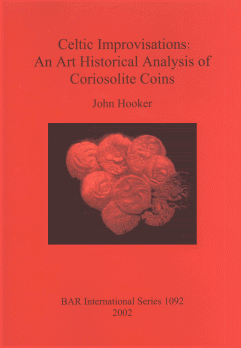
The article was about a hoard of coins, about 30% being of the Coriosolite tribe minted during Caesar's conquest of Gaul, but buried some time later. I compared the selection purchased by the Société to the profile of the hoard, itself. Even back then, I thought that it was hardly worthwhile publishing anything unless you had something new to say. I had rather a lot of new information to show the world. For a start, not all of the coins that were believed to be Coriosolite were of that tribe -- they were of a tribe called the Unelli. I also said that the hoards of coins found in Jersey were not buried by refugees fleeing from the Romans as was often (but not always) thought, but were essentially scrap metal buried after the war that was destined for recycling at Hengistbury, on the south coast of England. I had created (1986) a new taxonomy separating the evolutionary changes from arbitrary changes in hundreds of design elements in the die creation and had plotted the former in a cladistic structure of flow-chart design, replacing the old system of die linking the die products which had used only a few arbitrarily chosen elements to establish a rudimentary and inaccurate classification system of six classes. The new system revealed three different issues, and hitherto unknown and occluded geographical details. Gilding the lily, I also broke them down into fifteen groups just for ease of identification and created a paper expert system by which a child could catalog any coin in a minute or two. Later (1996), I converted this to a web application complete with hyperlinks to essays about various themes at different stages of the system. A PhD student at Hofstra featured the latter in her thesis. Nineteen years later, another hoard has been discovered, very close to the hoard I had written about in my first publication, and apparently of a similar composition. All of the reports, so far have again attributed the hoard to Coriosolites fleeing from Caesar's troops. I was not the only person to suggest that Le Catillon was later than the Gallic war. Colin Haselgrove had also thought that it was post-Caesar in the late eighties, while I was researching and working on my manuscript: Celtic Improvisations: An Art Historical Analysis of Coriosolite Coins . Of course, my publication of 1989 was obscure, and Haselgrove was mainly working on the coins of S.E. England so it is little surprise that the idea had not spread far. After Spink turned down the manuscript because it was too specialized for commercial publication, I published it on the web, for free, in 2000. Of course, there is a lot of nonsense on the web, and just because I had written something there, there is no reason that it should be taken at face value. However, almost at once, the web version was spotted by the archaeologist Sean Kingsley, who at that time was the managing editor for Minerva Magazine in London. He asked me to write a piece about my research and it was published as Celtic Improvisations: The Coins of the Coriosolites in volume 13 number 1 (2002). Being a commercial publication, it was not noticed by academia in general, and it was based on another hoard, so again, the information slipped by, unnoticed outside of the magazine's readership. Sean told me that the book should really be in hard copy, and he made a couple of phone calls -- the outcome of which was that it was published, that very year, in British Archaeological Reports, BAR International Series (1092), Oxford. I was very happy about that as I had made great use of the BAR Series in my research. It contained top notch research and was commonly ordered, by subscription, by most university libraries. I only got ten copies for my efforts, but was happy to be in such good company. But, as books became more expensive, and the economy declined, most university libraries could not afford to subscribe to that series anymore and, instead, just ordered the titles that fitted with their own areas of interest.
Around that same time, I had designed the content, and my wife, Carin Perron (1957-2003) had built the very first Celtic Coin Index online using data from the Institute of Archaeology at Oxford. As Oxford did not pay for this, although they wanted the service and had promised grant money, it became my own property. I was invited, by Professor Raimund Karl, to supply the entry for Celtic coinage in John Koch's five volume Celtic Culture A Historical Encyclpaedia and this set was published in 2005. Being such a monumental work, the authors could not possibly be paid, but were able to buy the set at half price from the publisher. I uploaded the hard copy version of Celtic Improvisations to Academia.edu, where it became a little more visible to the public as it was appearing on Google. Membership was free and the public could sign in as independent scholars. A number of people downloaded it, but even my local university library did not carry the actual hard copy on their shelves. Rather than waste my time with further academic publications, which are useful to produce only for those within that system, but of no use at all to independent scholars, and the public at large, I thought it might be a nice idea to go directly to the public, so this blog will have current research that is ongoing, and will be about a number of topics. There will also be links to an e-book or two that I will publish at a price that anyone can afford; perhaps a few guest spots from the cream of academia, and elsewhere; good friends, anecdotes and issues far removed from Celtic coins and Celtic art-- artistic, environmental, social, and just mundane but interesting stuff. Something for everyone. You never know what, or who, you might encounter here. Perhaps this is the way of the future! John Hooker